Topological Fantasmatic Ontology: Topofantology
Total Essay Word Count: 211,512
This site gathers essays, notes, fragments, formal constructions, and longer works developing Topofantology: a philosophy of Being, relation, representation, and non-closure.
Its first sustained systematic statement is Reality Does Not Close, which develops the central architecture of the philosophy across ontology, representation, Mind, language, AI, ethics, mathematics, art, theology, and world-formation. The book gives the project a coherent form, but it does not mark its completion. Topofantology remains a developing philosophy, and the essays collected here extend, revise, complicate, and sometimes place pressure on what has already been formulated.
That is not accidental.
The work begins from a simple conviction: Being does not appear as a closed whole. What we encounter instead are boundaries, intervals, asymmetries, relations, representations, returns, and provisional forms of coherence. Things stabilize, but never without remainder. Whatever becomes intelligible does so through differentiation, selection, exclusion, relation, and return.
For that reason, the individual texts on this site are not presented as final statements. Each arrives with its own limits, emphases, distortions, and discoveries. Something is clarified, and something else is necessarily left outside the frame. That incompleteness is not simply a practical limitation of writing. It belongs to the subject matter itself.
A philosophy of non-closure should therefore distinguish completion from closure.
An essay can be complete as an essay. A book can be complete as a book. An argument can arrive at a determinate conclusion. But none of these requires the stronger claim that the field from which it emerged has been exhausted. Local forms can close sufficiently to become transmissible while reality remains globally open.
This distinction matters. A perfectly sealed philosophy would contradict the structure Topofantology attempts to describe. If reality exceeds every representation of it, then thought should not disguise its own remainder. The aim is not to celebrate vagueness, error, or unfinished thinking. It is to pursue precision without mistaking precision for totality.
Reality Does Not Close is therefore not the final word of Topofantology. It is the first major stabilization of the system.
The essays are the continuing field around it.
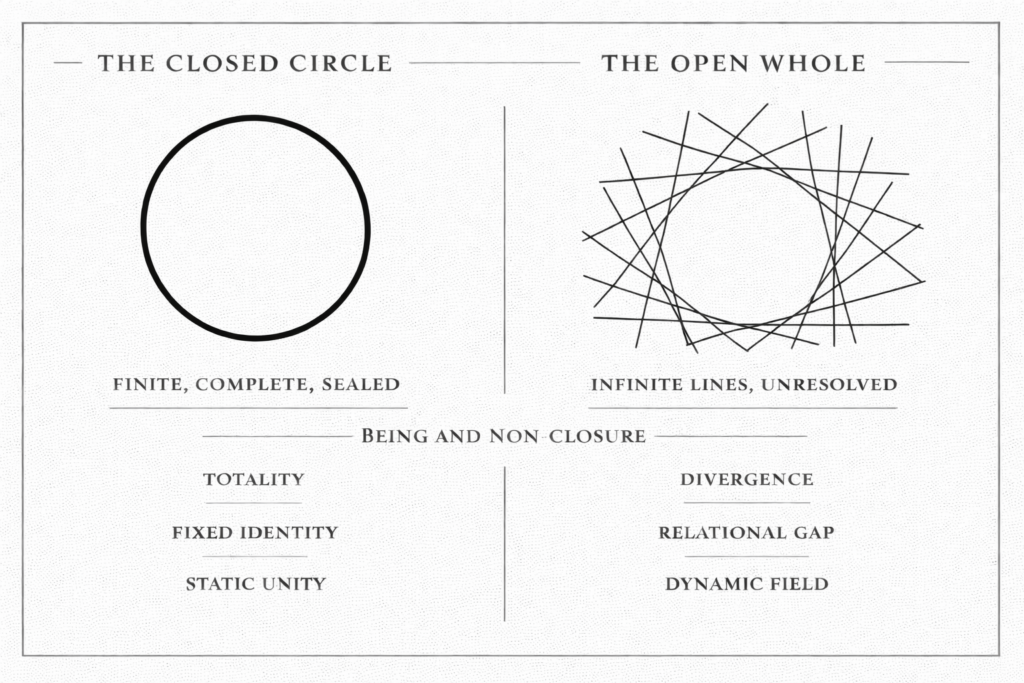
The right image presents an alternative: Being not as perfect closure, but as a circular effect generated through an indefinite set of trajectories. What appears whole is not sealed. It emerges through relation, repetition, and asymptotic approach. The form holds, but it does not finally close. Reality is therefore not a perfect circle but an open whole: coherent yet incomplete, structured by convergence without final resolution. Closure is an idealization; actual Being remains relational, generative, and marked by a remainder no representation completely absorbs.
This is close to what Topofantology means by Fantasy.
Fantasy is not merely invention, illusion, or escape. It is the operation through which a field becomes focused into form: an image, concept, boundary, identity, model, theory, world. Fantasy makes something visible by excluding something else. It produces coherence, but coherence always carries a remainder.
Every representation therefore contains both disclosure and loss.
A concept reveals by cutting.
A name stabilizes by excluding.
An image returns something by failing to return everything.
A theory becomes useful by reducing a field it cannot exhaust.
The question is not how to escape this condition. There is nowhere outside representation from which reality could be represented without remainder. The question is how to construct forms that remain aware of the outside they necessarily produce.
Taken individually, the essays on this site isolate particular problems, relations, structures, and pressure points. One follows the gaze. Another follows the circle. Another follows the boundary between body and Mind, the relation between human and machine, the structure of desire, the violence of representation, the ontology of mathematics, the architecture of God, or the recursive formation of worlds.
No individual essay contains Topofantology.
Their significance lies partly in what happens between them.
A distinction introduced provisionally in one text returns elsewhere under different pressure. A metaphor becomes an operator. An image acquires formal structure. A contradiction reveals that an earlier distinction was insufficient. A concept that seemed local begins to organize several domains at once.
The philosophy therefore develops recursively. Later constructions return upon earlier ones and alter what they mean.
This is also why contradiction is not automatically failure. Some contradictions are simply mistakes and should be corrected. Others reveal that two apparently opposed formulations belong to a larger structure that had not yet been made visible. The task is not to preserve contradiction for its own sake, but to determine whether it marks incoherence or the pressure of a more adequate form trying to emerge.
What gradually appears is something like a whole with an opening in it: coherent without being sealed, systematic without claiming totality.
One image for this remains the circle.
I do not take the perfectly closed circle to be fully real in the strongest ontological sense. What appears closed can instead be understood as the local effect of relations extending beyond the visible frame—trajectories whose convergence produces form without requiring absolute termination. The unity is real, but its reality does not depend upon perfect closure.
It depends upon the relation of incompletions.
Topofantology develops in the same way.
The book gives the philosophy a major form. The essays continue beyond it. Future books, arguments, formalizations, criticisms, revisions, and encounters will alter the field again. What matters is not preserving every earlier formulation but maintaining the generative architecture through which better formulations can emerge.
This site is therefore neither merely an archive nor merely a notebook.
It is the developing world of the philosophy itself.
Each text is a local stabilization: sufficiently formed to stand, sufficiently open to enter relation with what comes next. Together they construct something no individual text could contain.
The aim is not perfection, and it is not endless incompletion.
The aim is to give thought enough form to become real without forcing reality to stop where the form ends.
To let thought take the shape of its subject.
Reality does not close.